
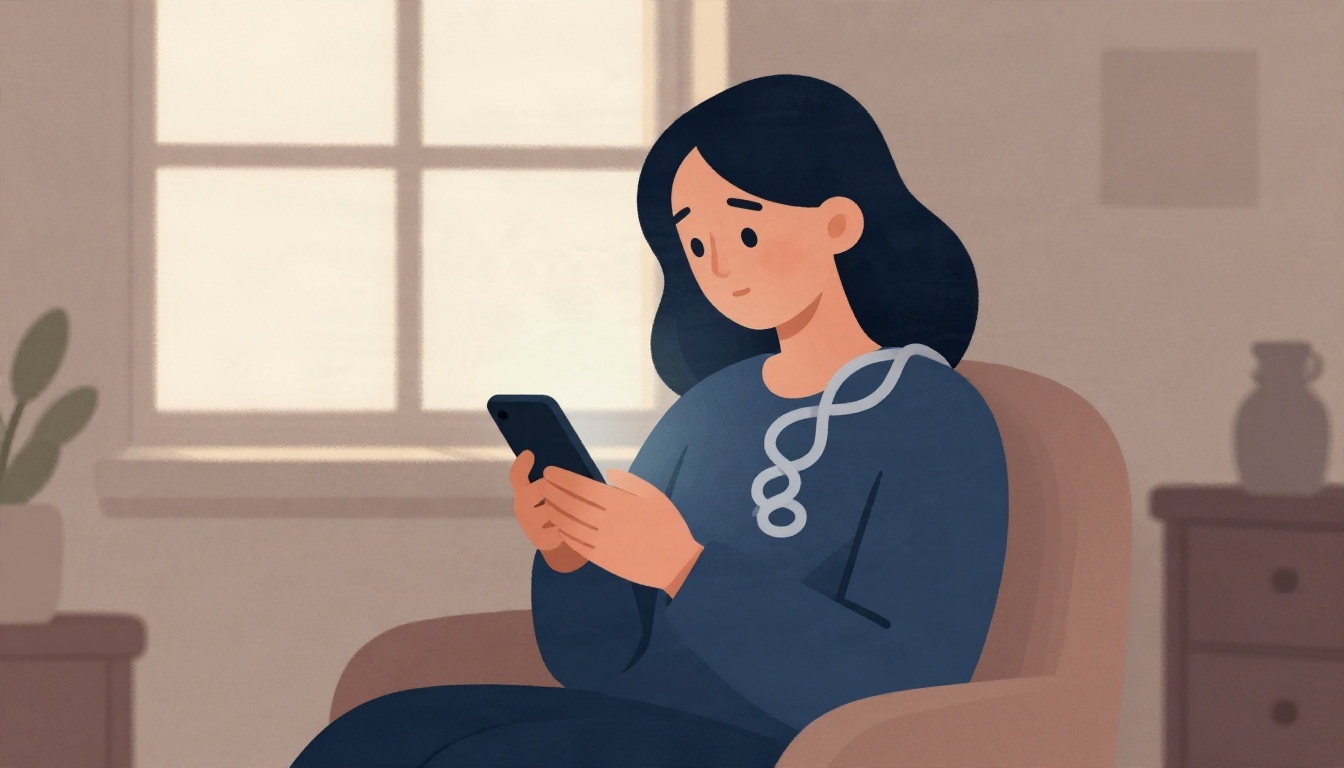
You reach for your phone during a 3 a.m. feed, and forty minutes later you're still scrolling through scary headlines, birth stories, and sleep-training debates. The scroll feels like research or connection, but it often leaves you more anxious than when you started. If that loop is eating into your rest and mood, you can interrupt it with a few concrete changes.
According to Harvard Health, doomscrolling is linked to which outcome?
Select one answer.
Why doomscrolling hits postpartum mothers especially hard
Doomscrolling means compulsively consuming distressing news or content, especially on platforms with endless feeds. Harvard Health notes that it is linked to worse mental well-being and life satisfaction, and that it can evoke greater levels of existential anxiety. The American Brain Foundation explains that constant negative stimuli reinforce negative thoughts, increase irritability, and raise anxiety.
That matters because maternal mental health conditions are common. The Policy Center for Maternal Mental Health reports that maternal mental health disorders are the leading complication of childbirth, impacting 20% of U.S. women, and that between 2016 and 2023 mothers reported a nearly 65 percent increase in "fair to poor mental health." When you are already depleted, a feed engineered to keep you watching can deepen the spiral.
Notice your two scrolling patterns
Postpartum anxiety often shows up in two scrolling styles: the obsessive search for the "perfect" answer, and the passive late-night scroll through upsetting content. Before you try to quit, track one day of use. Note when you pick up the phone, what you were feeling, and how you felt afterward. This baseline tells you which pattern to target first.
A practical checklist to break the loop
Use these steps in order. You do not need all of them on day one.
- Set app limits and timers. Use your phone's screen-time settings to cap the apps where you lose the most time. Scripps Health recommends setting limits for non-essential use and using timers or apps to monitor usage.
- Turn off non-essential notifications. Fewer pings means fewer unplanned pickups.
- Create a phone-free wind-down. Turn off screens 30 to 60 minutes before bed to help you wind down, as suggested in digital reset guidance.
- Curate your feed. Mute or unfollow accounts that spike your anxiety, and follow a small number of trustworthy sources instead.
- Replace, don't just remove. Keep a short list of offline alternatives for feeding sessions: an audiobook, a paper book, music, or a puzzle.
- Use airplane mode during feeds. If you cannot resist the feed, remove the option for that one session.
- Check your mood after each session. If a scroll leaves you tense, that is data, not failure.
When scrolling is a symptom, not just a habit
If you are scrolling to manage racing thoughts, checking behaviors, or a sense of dread that will not settle, the phone may be a coping tool for something bigger. Postpartum anxiety and depression are treatable, and digital tools can help when they connect you to real support. A randomized trial presented at the Society for Maternal-Fetal Medicine found that first-time mothers who received a smartphone app with mental health self-management tools and access to a care manager reported significantly fewer symptoms of stress, depression, and anxiety than those who received usual care.
The lesson is not that all screen time is bad. It is that the quality and direction of your digital use matters. A tool that connects you to care is different from a feed that keeps you in fear.
A simple weekly reset
Once a week, review your screen-time report. Pick one app to limit further and one offline replacement to protect. Keep the changes small enough that you can repeat them. If your mood is worsening or anxiety is interfering with sleep and caregiving, reach out to a clinician rather than trying to scroll your way to certainty.
How the Featured Expert Can Help
Rooted Postpartum Care offers holistic mental health and nutrition-focused care for new mothers across Maryland, Washington DC, and Wyoming. The practice, led by psychiatric nurse practitioner Natalie Marchione, provides virtual, individualized support for postpartum anxiety, depression, and burnout. You can learn more at Rooted Postpartum Care.
Quick quiz
Doomscrolling has been linked to which of the following?